

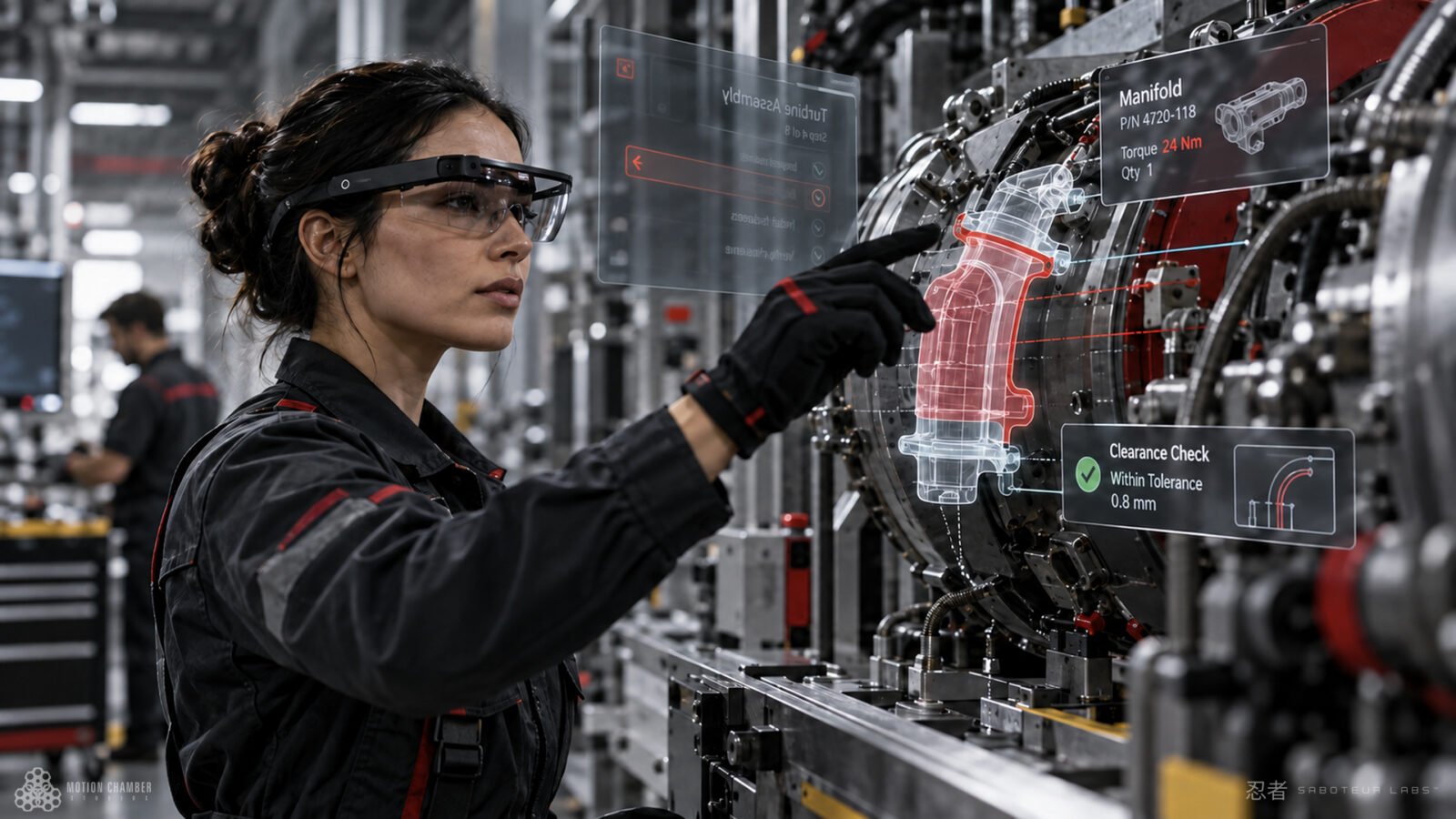
Spatial computing becomes considerably more interesting when the technology stops being the experience and starts helping someone do actual work.
For years, augmented and mixed reality have frequently been demonstrated through spectacle.
Virtual objects float in rooms. Large screens appear in empty space. Digital characters stand on tables. Architecture can be previewed before it exists.
Those demonstrations were valuable because they established what the technology could do.
They did not always establish why someone needed it.
That distinction is beginning to narrow.
Snap’s latest push around its Specs augmented-reality glasses includes enterprise partnerships involving Salesforce, Nvidia and Amazon Web Services, with applications aimed at environments such as manufacturing, retail and field service. Snap is also positioning its new Specs Intelligence service as an anticipatory AI layer that can operate across devices. Reuters
The interesting part is not another pair of glasses.
It is where the information is moving.
For decades, digital work has required people to leave the physical task—at least cognitively—and consult a screen.
A technician looks away from equipment to read documentation.
A worker checks a tablet for the next assembly step.
A field engineer compares a physical installation with a drawing.
A designer views a three-dimensional object through a two-dimensional viewport.
Spatial interfaces begin to remove that separation.
Information can exist where the information matters.
A tolerance can appear beside the component being measured.
An assembly instruction can remain aligned with the part being installed.
A model can be evaluated at physical scale.
A remote specialist can indicate a location rather than describing it verbally.
The computer becomes less of a destination and more of a layer embedded into the environment.
That is a much more practical definition of spatial computing than simply expanding the desktop into three dimensions.
It also suggests that some of the strongest spatial experiences may be relatively restrained.
A useful industrial AR system does not necessarily need floating windows filling a worker’s field of vision. In many situations, the best interface may consist of one highlighted component, one measurement and one next action.
Good spatial design will probably require more discipline, not more graphics.
Physical environments already contain enormous amounts of visual information. Machinery, architecture, vehicles, people, tools, signage and hazards are competing for attention before a digital layer is introduced.
Every additional graphic has a cost.
This makes context central to the design.
What information matters at this location?
At this moment?
From this viewing angle?
For this particular person?
That is where AI and spatial computing begin to reinforce one another.
Computer vision can help a system recognize objects and environments. Spatial mapping can establish where those objects exist. AI can interpret the task being performed. The interface can then surface information based on that combination.
Instead of the user navigating through software to find information, the environment itself becomes part of the query.
Look at a component.
Identify it.
Understand its current state.
Retrieve the relevant information.
Act.
The conceptual shift is subtle but important.
We are not simply putting computers on people’s faces.
We are beginning to design computing systems that understand that people already inhabit a three-dimensional interface: the physical world.
The opportunity is to augment that world without overwhelming it.
As spatial hardware becomes lighter, AI becomes more contextual and 3D systems become easier to deploy, the strongest applications may look less like science fiction than expected.
They may simply look like somebody doing their job—with exactly the information they need appearing exactly where they need it.
MCS takeaway: Spatial computing becomes useful when digital information stops competing with the physical world and starts understanding its place within it.
Visual direction: the technician image deliberately treats AR as a working instrument. The physical machine remains primary; the interface exists only to clarify the task.