

Artificial intelligence learned language first. Increasingly, it is being asked to learn the world that language describes.
Much of the current AI boom has been built around information that fits naturally inside a computer.
Text.
Images.
Audio.
Code.
Documents.
Databases.
But many of the problems humans need to solve do not exist primarily in those formats.
They exist in rooms, products, machines, roads, buildings and objects.
They have depth.
Mass.
Distance.
Material.
Movement.
Constraint.
That is why the growing interest in physical AI and spatial intelligence deserves attention.
AMD recently announced an agreement to acquire World Labs, the AI research company led by Fei-Fei Li, in an $8.2 billion transaction. Both companies describe the work in terms of AI systems capable of reasoning about spatial and physical environments, with potential applications across areas including robotics, simulation and design. Reuters
AMD has also been emphasizing physical AI at the edge, where sensor processing, inference and embedded computing can happen closer to the machines and environments generating the information. AMD
The broader direction is significant.
A language model can tell you what a gearbox is.
A spatially intelligent system must begin to understand where its components are, how they relate to one another, whether they can occupy the same space and what might happen when they move.
That is a substantially different problem.
The difference can be thought of as the difference between describing an object and understanding an object.
For designers, engineers and visualization teams, this creates an interesting convergence.
CAD systems already contain precise geometric descriptions of products.
Digital twins represent physical systems digitally.
Photogrammetry and scanning capture existing environments.
Simulation models how systems behave.
Computer vision recognizes objects.
Generative systems create new variations.
Physical AI begins connecting these formerly separate territories.
A future intelligent system may not simply generate an image of a component. It may understand the component as geometry within an assembly.
It may understand that a surface cannot pass through another surface.
That a human hand requires clearance.
That an object has orientation.
That a machine has operating states.
That a room has entrances.
That gravity exists.
Those sound like obvious properties because humans learn them almost immediately through experience.
For computers, they represent an entirely different kind of intelligence.
This is also why the boundary between “digital” and “physical” is becoming increasingly unhelpful.
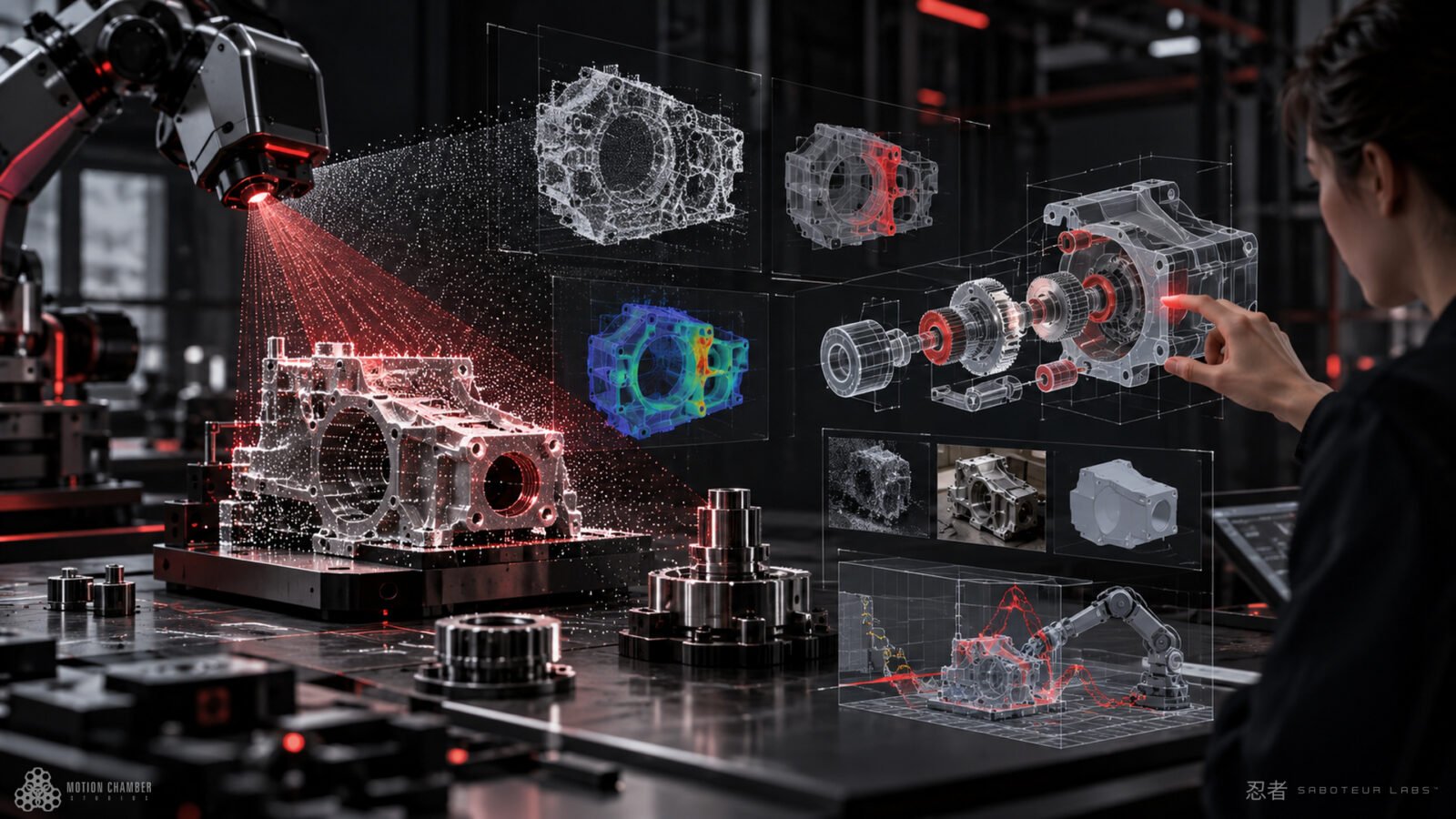
A product may begin as a sketch, become a parametric model, move through simulation, exist as a digital twin, be manufactured physically, scanned back into a digital environment and later become part of an augmented-reality interface.
Which stage is the digital one?
Increasingly, all of them are.
The more useful distinction may be between representations of reality and systems that remain connected to reality.
That has implications well beyond robotics.
Product visualization can become product intelligence.
3D environments can become simulation spaces.
Digital twins can become operational interfaces.
Spatial experiences can react to real geometry rather than approximate it.
Design data can remain useful after something has been manufactured instead of ending when production begins.
In other words, 3D stops being merely a presentation medium.
It becomes infrastructure.
The transition will not happen at once, and many of the systems being built today remain experimental. But the direction is becoming visible across hardware, AI research, robotics, simulation and spatial computing.
AI is moving out of the document.
It is beginning to encounter the object.
MCS takeaway: When AI understands space, geometry and physical relationships, digital design stops being a representation of the real world and becomes part of how the real world is understood and operated.
Visual direction: the scanning/manufacturing image represents the loop between physical object, spatial capture, engineering model, simulation and intelligent interpretation. The subject is not robotics—it is continuity between digital and physical systems.